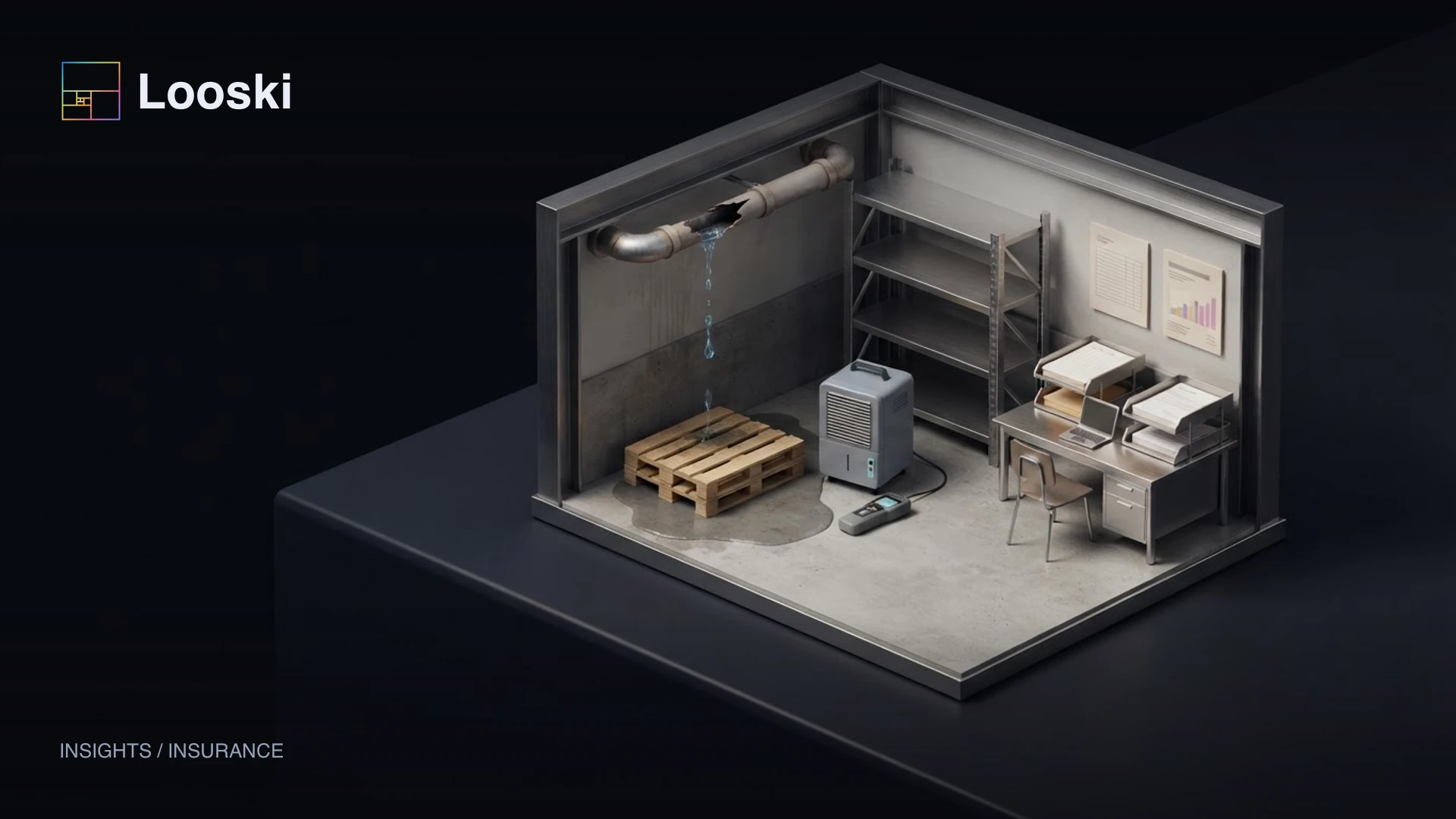
A new upload to a property claim is not necessarily new evidence about coverage. It might be another drying-equipment invoice or a revised repair estimate. Running the same full claim-analysis prompt on every supplement wastes work and makes the evidence trail harder to follow.
What this means for your business
For a commercial-property claims team, CLM suggests a narrower opportunity: classify the incoming material and activate the right review task. This could reduce repeated analysis while helping adjusters see what changed. The model does not establish coverage, causation, reserve adequacy or settlement value.
CLM-v0.1-8B scores supplied choices instead of writing an answer. Its two projection heads use a frozen Qwen3-8B encoder. That makes it a candidate for deciding which workflow should run next. It does not extract a complete record, execute a tool or prove that a document is correct. The model card and implementation are linked below.
A specific workflow: supplemental drying charges
A fictional warehouse water-loss claim receives a contractor invoice for three additional days of dehumidifier rental. The packet also contains moisture readings and a short email saying the drying period was extended. The original mitigation invoice is already in the claim file.
After local OCR and document parsing, CLM scores document-purpose choices: mitigation-cost supplement, building-repair estimate revision, contents inventory, adjuster correspondence, or manual review. A separate question can flag that the packet contains more than one document purpose. Keep the claim identifier and verified loss details in structured fields, rather than asking the classifier to infer them.
The proposed mitigation-supplement route retrieves the original equipment schedule and relevant drying logs. A specialist extraction workflow aligns rental dates and equipment identifiers. Deterministic comparisons flag overlapping billed days, and the adjuster receives a proposed review task with the supporting pages. The workflow does not wake the contents-valuation agent or ask a broad model to rewrite the entire claim summary.
That is the potential acceleration: a smaller retrieval set, one appropriate specialist and no repeated full-file generation for a routine supplement. If the new material introduces an unresolved cause-of-loss issue or cannot be linked reliably, it goes to an adjuster. A low-cost document category must never be treated as permission to skip a required review.
A compact on-site deployment
The lightweight part is the scoring layer. The full service still needs the Qwen3-8B encoder. As a sizing calculation, eight billion weights at two bytes each occupy roughly 16 GB before runtime memory, activations and serving overhead. A single Linux workstation with a supported 24–32 GB GPU is a reasonable starting configuration to evaluate for short inputs and modest concurrency, not a tested minimum or a throughput promise.
The reference implementation pairs a vLLM pooling service with the CLM API. Keep decision inputs short, precompute reusable candidate embeddings, and batch arrivals within an acceptable waiting window. The repository's example caps inputs at 2,048 tokens; split longer documents into meaningful sections and retain page references instead of silently truncating evidence. One encoder can serve several department-specific sets of choices.
Four-bit weights would be roughly 4 GB in raw weight storage by arithmetic, but that is not the total memory requirement. Quantization changes embeddings and may change rankings. Validate the exact encoder, pooling method, precision and heads together before buying smaller hardware. The supplied heads cannot simply be attached to any small embedding model. A tiny CPU appliance or a Mac mini is not a verified drop-in deployment for this reference stack.
Keep the claim file and its classification together
For claims operations with established local infrastructure, on-site inference keeps loss descriptions, contractor documents and cached representations within the controlled claims environment. Run OCR and any subsequent summarizer locally if that is the intended boundary. Apply file permissions before retrieving evidence; the model should never receive the whole insurer's document store by default.
Record which supplement produced which task, the candidate set used and the adjuster's correction. Retention and access policies should cover embeddings and logs as well as original PDFs. Local infrastructure needs monitored backups and a working manual intake path; physical location alone is not an access-control policy.
Measure supplements, not benchmark leaderboards
Replay closed-claim supplements labelled by experienced handlers. Include mixed invoices, revised estimates and poor scans. Measure wrong-workstream assignments, repeated full-file reads, adjuster corrections and time to a usable review packet. Compare the entire pipeline, including OCR and retrieval, because those stages may dominate latency even if classification is fast.
The release is an early candidate-ranking model. Published agent benchmarks do not establish accuracy or speed on this workflow. Scores are relative to the alternatives supplied, not calibrated probabilities that a business decision is correct. Include an explicit manual-review choice, then set abstention rules using held-out examples; adding that choice alone does not make the system safe.
Frequently asked questions
Does this automate coverage decisions?
No. It proposes document-handling routes. Coverage, causation and settlement decisions remain in the insurer’s established review process.
How lightweight is the full on-site service?
The scoring heads are small, but the encoder has roughly eight billion parameters. Raw 16-bit weights alone are about 16 GB. A 24–32 GB GPU workstation is a sizing hypothesis for evaluation, not a verified minimum; runtime memory and workload matter.
Are these workflow speed improvements measured?
No. These are proposed workflows using fictional examples. Measure the full pipeline against your baseline, including routing accuracy, review time, retrieval and downstream model calls.